AI-powered website search: Have a conversation with your content
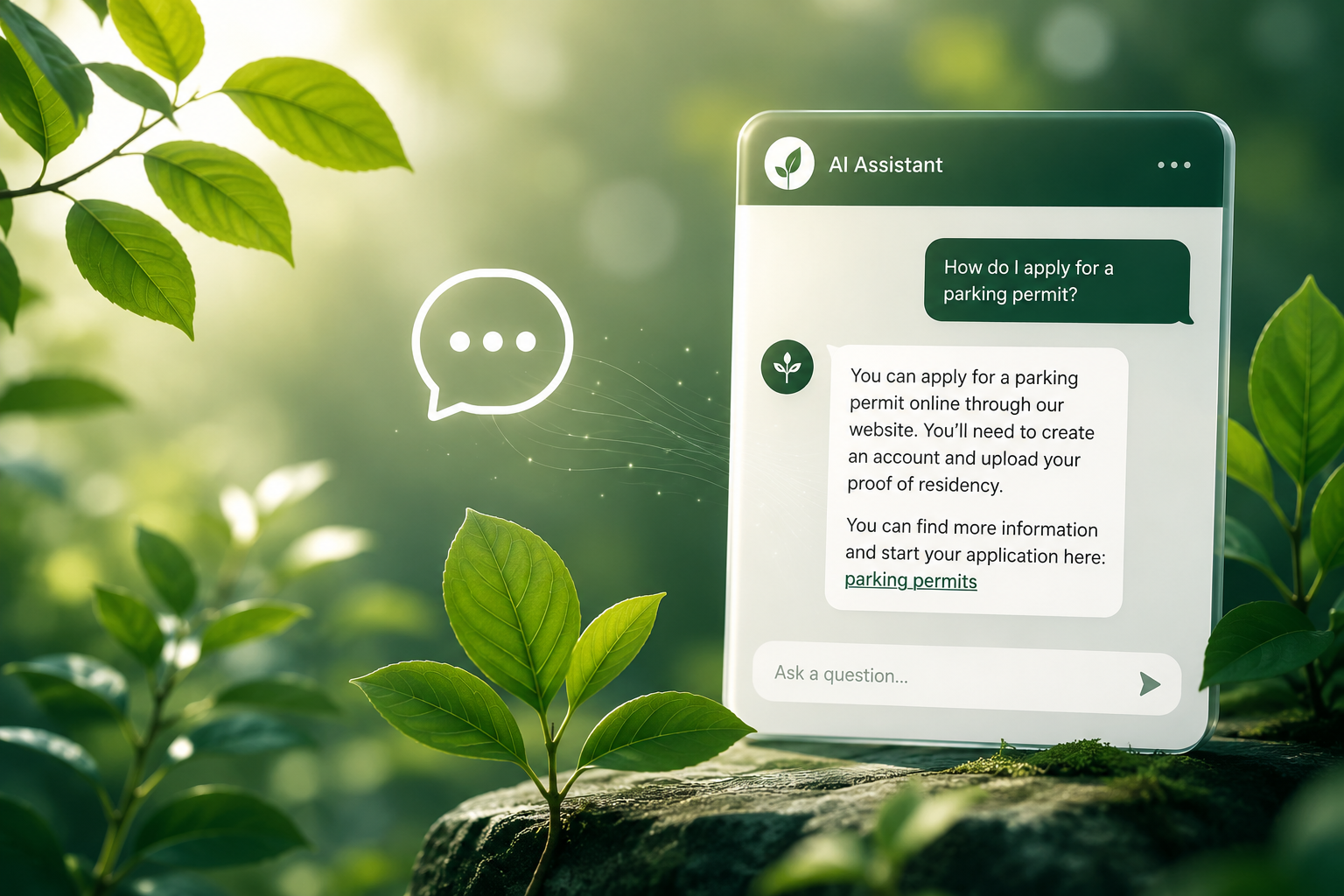

For organisations managing large volumes of content, this presents a significant opportunity. AI-powered knowledge assistants can transform websites, document libraries and intranets into conversational experiences, helping users find information faster while unlocking greater value from existing content.
From search to conversation
Traditional website search relies on users knowing exactly what they are looking for and choosing the right keywords to find it.
The reality is that most people don't think in keywords. They think in questions.
Instead of searching for "waste collection policy", they ask:
"My bin wasn't collected this morning. What should I do?"
Instead of searching for "planning controls", they ask:
"Can I build a granny flat on my property?"
Instead of searching through pages of university information, they ask:
"How do I defer a subject?"
AI-powered knowledge assistants allow users to ask questions in natural language and receive contextual answers drawn from trusted content sources.
Rather than returning a list of search results, the assistant can provide a direct response and guide users to relevant pages, documents and resources.
The experience feels less like searching and more like having a conversation.
Unlocking the value of existing content
Many organisations already have extensive repositories of policies, procedures, reports, publications, forms and frequently asked questions.
The challenge is often not creating content — it's helping people find it.
Over time, websites become larger, content becomes harder to navigate and valuable information becomes increasingly difficult to discover.
AI knowledge assistants can help organisations unlock greater value from their existing content by making it more accessible, discoverable and useful.
Whether it's a public website, member portal or staff intranet, users can simply ask a question and receive a relevant answer based on approved content sources.
Built on trusted information
One of the most common concerns around AI is accuracy.
For organisations operating in government, education, healthcare and other regulated environments, trust is critical.
Modern AI knowledge assistants can be designed to provide answers based on approved organisational content rather than information sourced from across the internet.
This allows organisations to maintain greater control over the information being presented while providing users with a more intuitive experience.
Responses can also include links back to the original source material, allowing users to verify information and explore topics in more detail.
With appropriate governance, access controls and human oversight, organisations can confidently deliver AI-powered experiences while maintaining trust and accountability.
Practical applications
AI-powered knowledge assistants have applications across almost every sector.
For local government, they can help residents find information about council services, planning requirements, waste collection, facilities and community programs.
For universities and education providers, they can support students and staff with access to course information, policies, procedures and support services.
For membership organisations, they can provide members with instant access to resources, guidance and frequently asked questions.
Internally, knowledge assistants can also help staff quickly locate policies, procedures, templates and organisational information without searching across multiple systems.
In many cases, organisations already have the content. AI simply makes that content easier to access.
The future of digital platforms
AI is not replacing good content strategy, information architecture or user experience design.
Instead, it is creating a more intuitive way for users to access information.
The organisations that will benefit most are those with strong content foundations, clear governance and a focus on delivering genuine value to users.
As AI continues to mature, conversational experiences are likely to become an increasingly important part of how organisations deliver information and services online.
The future of website search may not be search at all.
It may simply be a conversation.